Join Martial Arts Club
Martial arts belts explained: karate, judo, taekwondo and BJJ grading
Coloured belts are a way to show progress and to group students by experience. The modern kyu and dan system came from judo founder Kano Jigoro in the late 1800s, and karate and other arts later adopted similar systems. Here's how the main ones work.
The basic idea: kyu and dan
- Kyu grades are student grades. They usually count down, for example from 10th kyu (beginner) to 1st kyu (just below black belt).
- Dan grades are black-belt grades. They count up from 1st dan (shodan).
Karate
Most karate styles use kyu grades with coloured belts, then dan grades for black belt. The colours and their order differ between styles and organisations: one club might go white, yellow, orange, green, blue, purple, brown; another might use red or extra stripes for juniors. Ask your club for its syllabus.
Judo
Judo also uses kyu and dan grades. Senior dan grades may wear a red-and-white belt and, at the very highest levels, a red belt. Kyu belt colours vary by country and national federation. Many clubs use a separate junior system with more steps for children.
Taekwondo
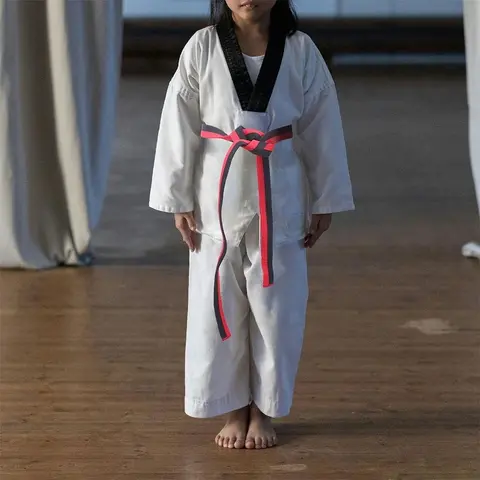
Taekwondo uses gup (geup) grades, counting down from 10th gup to 1st gup, then dan grades for black belt. Under the Kukkiwon system used by World Taekwondo, children below 15 earn poom grades (often a red-and-black belt) instead of dan, converting to dan when they're old enough. ITF taekwondo uses its own colour order.
Brazilian Jiu-Jitsu
BJJ has few belts and promotes slowly. Under the International Brazilian Jiu-Jitsu Federation (IBJJF) system, the adult belts are white, blue, purple, brown and black, with up to four stripes on each belt before the next promotion. There are minimum ages and minimum time-in-grade requirements for adult belts, and a separate kids' system (grey, yellow, orange and green belts, with white or black bars). Promotions are usually at the instructor's discretion rather than through a formal test.
What a grading involves
In karate, taekwondo and judo, gradings are usually formal tests: basics, forms (kata or poomsae), self-defence, sparring and sometimes theory. Many clubs charge a grading fee and have a minimum training time between gradings. Ask about both before you join.
Don't chase the colour
Belts mean different things at different clubs. A club that promotes everyone quickly, or charges large fees for each grading, isn't necessarily better. Focus on good coaching and steady progress. The belt will come.
Ready to start? Find a club in the directory.
Frequently asked questions
How long does it take to get a black belt?
It depends on the style, the club and how often you train. In many karate and taekwondo clubs it's commonly several years of regular training; in BJJ it's often around a decade. Be wary of any club that promises a fixed short timeline.
Do all clubs use the same belt colours?
No. Apart from white for beginners and black for advanced grades, colours and order vary between styles, organisations and even clubs.
Sources and further reading
- IBJJF graduation system (International Brazilian Jiu-Jitsu Federation)
- World Taekwondo (World Taekwondo)
- International Judo Federation (IJF)
- World Karate Federation (WKF)
Sources checked 17 November 2026. Rules and advice change, so follow the official page if it differs from this guide.